

“It took you a while to come to the door.”

If there’s any reason someone might be hesitant to see The Invite, the new film from director Olivia Wilde, it’s due to an aversion some people may have to awkward humor. Such writing has the ability to make certain moviegoers uncomfortable and anxious to the point where they potentially miss dialogue and nuance that moves the story forward. Yet when done right, a film built on awkward humor can transform itself into a comedy of manners that becomes hilarious not just because it’s happening to somebody else, but because in illustrating such moments cinematically, the audience is able to empathize with the characters experiencing those emotions and allow them the opportunity to laugh at their own similarly nerve-wracking real-life situations. The Invite is one of those that does it right, but where the film really scores is in its quartet of characters, each of whom becomes more and more intriguing with every passing scene.

In The Invite, longtime married couple Joe (Seth Rogen) and Angela (Olivia Wilde) are having their upstairs neighbors Pina (Penelope Cruz) and Hawk (Edward Norton) over for dinner. However, there’s tension before the evening starts thanks to the growing frustrations between the hosts. When Pina and Hawk show up, the gathering becomes a night full of surprising exchanges and unexpected revelations, all of which cause Joe and Angela to reassess their marriage.

As I said before, The Invite works as a never-ending comedy of manners, but its heartbeat is in its characters. The film’s central couple, Joe and Angela, are presented right off the bat as having a highly compromised marriage that is made up of various levels of hostility and punctuated with a stream of biting remarks. The irony, of course, is that on the surface, Joe and Angela are the couple who have everything- youth, health, and a gorgeous, sprawling apartment in the heart of San Francisco. However, The Invite works by dispelling the relentless stereotype that what a person may possess has nothing to do with how unfulfilled they can still be. In Joe’s case, the lack of fulfillment comes from working a job that’s far below what he strived for, and for Angela, it’s being an artist whose once-creative drive seems to have left her. Above all of that, though, the two seem to have lost that shared energy and chemistry that connected them in the first place and allowed them to find peace, contentment, and love within each other. The script by Will McCormack and Rashida Jones is telling enough to let us imagine an earlier version of this couple where they did bring out the best in one another. But it’s the present day, and regardless of who they might have been before, Joe and Angela are now a couple who have spent years cultivating a marriage and designing their lives so that they don’t have to deal with what they should be dealing with, specifically the hard realization that they may have lost whatever it was they once had.

If Joe and Angela are struggling to hold it together, Hawk and Pina seem to have figured it out. The two of them do play into the stereotype of the cool, carefree, sexy couple who are beautiful to look at, are clearly enamored with each other, and are comfortable enough within their relationship to have multiple sexual partners. At a certain point, I started to wonder if the pair might actually be imaginary figments of Joe and Angela’s imaginations, or whether they were conjured up by fate and the universe in order to give their hosts something to aspire to. It certainly looks like Hawk and Pina have managed to avoid the slings and arrows that Joe and Angela have been struggling with. Eventually, however, the guests do reveal themselves to be very human people with lives that have been lived. This is especially true of Hawk, who has had to endure his own tragedy. Eventually, it’s revealed that he and Pina have only been dating for a little less than a year. This detail might cause some to rationalize that their behavior is the result of being in the honeymoon phase, but it speaks to something more meaningful. Being older than their hosts, and with more life behind them, Pina and Hawk represent each other’s second chances after coming out the other end of their respective pasts. If this means they’re not figments of the imagination, then they’re almost certainly guardian angels sent to make Joe and Angela recognize the differences between what they want, what they need, and what they have.
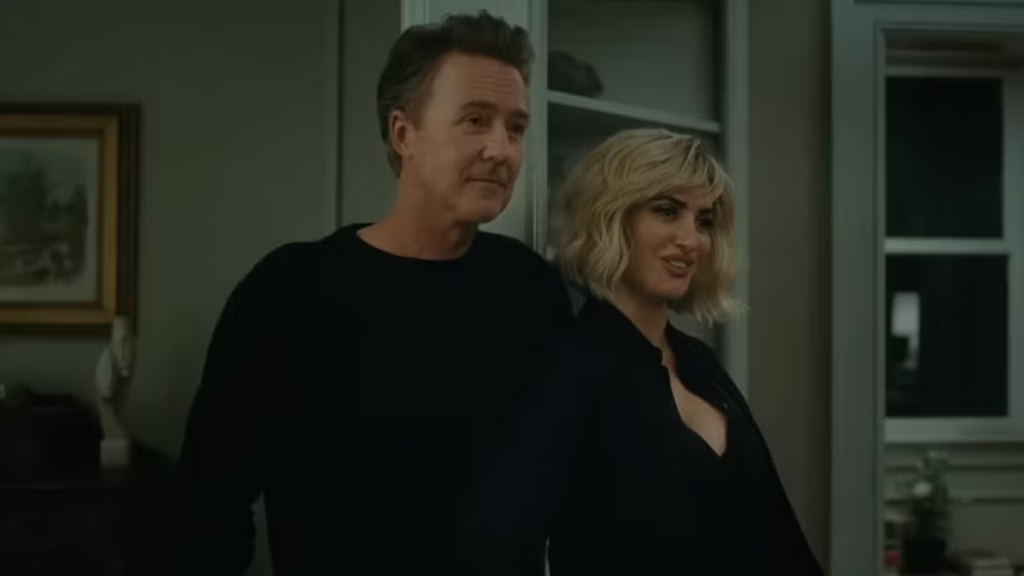
Besides having one of the year’s best scripts, The Invite also boasts one of the best acting ensembles of 2026. Each actor is deserving of a space on every critic’s long list. Rogen, Wilde, Cruz, and Norton all carve out their own specific character moments, while also finding the groove that allows them to work as an incredibly cohesive unit that is never once out of step. The four actors all turn in some of the best performances of their careers by taking their characters beyond the images the film initially sells them as to reveal each person as something more.

The Invite is very much a timeless film. With the exception of only one or two modern references in the nearly 100-minute runtime, it isn’t hard to picture this piece existing in any age. It’s not an easy task to capture such a feel, especially in an age when society is so eager to categorize everything that comes along as either dated or bold. Wilde’s film saves itself from such labels in every aspect of its construction, from the fashions to the set decorations, and especially in the lived-in cinematography by Adam Newport-Berra. It should also be pointed out that the film’s camera movements are fairly invigorating and never once make the exercise come across as stagey. For a movie that more or less takes place in only one location, that’s quite the feat. If The Invite feels like both a call back to yesteryear that also manages to come across as fresh, it’s because its themes of love, relationships, and dissatisfied people still longing to connect will always feel relevant.

